December 15, 2019

The Mini Cheetah Robot

Back during my second year of undergrad I started scheming about building legged robots out of cheap hobby brushless motors.  Two years later as a senior, I finally made a first-pass at building some of the hardware - motor controllers, gearboxes, and a two-degree of freedom leg.  Things look promising, so I stayed at MIT to do a masters in Sangbae's lab continuing the project.  The Mini Cheetah robot is the result of that work:

Photo: Bryce Vickmark

First quadruped robot to do a backflip!

The first version of the robot was put together in March 2018.  I spent the summer after finishing my Masters helping get the robot fully up and running (literally).  When we saw how well everything worked, we decided to build a handful more of the robots, both for our lab and to loan out to other research groups to experiment on.  I spent about a year doing some design revisions and building 10 more of the robots.

The robot is probably best documented in my masters thesis, but there are also several blog-posts as well.

Here are several papers (in no particular order) published about the robot or  using it.  I'll keep updating this list as I hear about more publications using the robot


The Rubik's Contraption

Jared Di Carlo and I built a machine that can solve a Rubik's cube really fast, and it became kind of internet-famous:

Planar Magnetic Headphones

I built a pair of planar magnetic headphones - basically just because I though the operating principle was interesting.  After several catastrophically bad-sounding attempts, I eventually built a version that sounded decent and looks pretty good:


The drivers are meticulously hand-etched from the thinnest flex-pcb material I could find.  The driver membrane is sandwiched between an arrangement of magnets embedded in the aluminum grill that makes up most of the structure of the headphones.

See the build-log here for details

Furuta Pendulums

In the summer of 2016 I built a desktop furuta pendulum out of random parts I had lying around:


Recently, I redesigned it to not be built out of scraps, sent out for all the machined parts, and assembled a handful more:

Motor Dynamometer

In 2016 I built an electric motor dynamometer - a device for characterizing the performance of electric motors and motor controllers


The dynamometer is controlled by a Python and QT-based interface which provides manual control of the torque, speed, voltage, and current, simulates loads, or runs through sequences of test points.
The dyno lets me characterize electric motors to generate useful data like efficiency maps:


See the build log here:

Machined Electric Travel Ukulele

In December 2015 (4 whole years ago!)  I machined an electric ukulele out of some aluminum, stainless steel, and brass.  The whole thing was built over the course of less than a week, with no computer aided design save for the fret-board.


It's a headless design with the tuners built into the body.  Under the carbon fiber cover at the center is a home-made low profile pickup.  The body was hand-shaped using a combination of a bandsaw, manual milling machine, and hand-filing.

December 21, 2015

Benchtop Lathe

After stumbling upon the bed, carriage, and tailstock from a Taig lathe, I rebuilt the lathe, making all the parts I didn't have already.  This includes new cross slide and compound slide, a new headstock and spindle with integrated taper for ER32 collets, and brushless spindle motor with a DC custom power supply.


Here's the build log (and many more pictures), which will be occasionally updated as I add features like auto feed and chucks.

December 29, 2014

2014 East Campus Roller Coaster


Since working on the rotating climbing wall last year, I've been interested in trying to revive the East Campus roller coaster.  Fellow MechE 2016's Jaguar K. and Wesley L. were similarly enthusiastic about the roller coaster, so we started coming up with ideas over that fall semester.  We got an early start on the approval process for the ride, and, thanks to lots of hard work from our Rush chairs and others, we were able to get the permitting and approval from MIT and Cambridge in time.

After a week of construction, we had a working roller coaster:

Photo credit to the folks at monograph.io

More documentation of the roller coaster's design and construction can be found here.

September 30, 2014

iPad Retina Display External Monitor

Two summers ago I bought an iPad 3 LCD off ebay.  These are 9.7" 2048 x 1536 IPS panels, which use an internal DisplayPort interface.  In May, I finally got around to building an external display out of the panel, which can be clipped directly onto the side of my Macbook Pro's screen, and is powered by a USB port.

I have been using the display on a daily basis for the last four months, and it has held up beautifully.  It took a little while for my eyes to get used to the tiny 264 pixels-per-inch pixel density, but I can now comfortably use it at native resolution.


The display's build log can be found here.


December 2, 2013

All Terrain Scooter Redux

The original version of my all-terrain electric scooter suffered from a number of problems, the most important of which was in the motors I used.  The triple CIM motors were just not capable of providing both the top speed and acceleration I wanted out of the vehicle.  Actually they could, but just not for very long before the insulation on their windings turned into a melty black mess.

After some attempted snow-scootering during the northeast snowstorm last year, I decided I was sick of the freshly roasted motor smell, and stored away the scooter until the summer.  A full teardown of the scooter revealed enough unnoticed or impending failures that I decided to scrap pretty much the entire mechanical end of the original scooter.

Version 2 features the same HobbyKing LiPo battery pack and Kelly 72V 200A brushed motor controller as the original, but nearly everything else is new.  Replacing the CIMs are a pair of Magmotor S28-200's, which are slightly larger than the S28-150's of battlebot fame.  Like before, the motors are mechanically coupled to one output shaft through a gearbox reduction, and connected electrically in series.

This version also has even bigger wheels (because the old ones clearly weren't large enough...), and over a foot of clearance everywhere.


The scooter's build log can be found here.

October 5, 2013

Gourd Ukulele

Back in June, I returned to Atlanta for a couple weeks.  While there, I took advantage of all the woodworking hand tools I had access to, and made this ukulele.  The body of the instrument was made from a dried gourd.  The neck is mahogany, which was scavenged from the desk in my old bedroom.  The fretboard is burned oak, which was split off a stump in my back yard, and the soundboard was the bottom of a desk drawer.

The ukulele is about Tenor sized, and tuned with a low-G.  Fret positions were determined using this handy online fret calculator.  All of the construction except drilling a couple of holes was done with hand tools.  The neck was shaped mostly with a drawknife, except for the channel for the tuning pegs, which was chiseled out.


The ukulele's build thread can be found here.

I don't have any audio or video clips of me playing it, so you'll have to take my word for it that it sounds pretty good.  I think it does, at least.  Not that I have much to compare it to.

September 4, 2013

Rotating Climbing Wall

For REX this year at East Campus, I helped to design and build a rotating climbing wall.

The climbing wall consisted of a twelve-foot diameter by eight-foot wide wooden cylinder suspended on an axle.  The surface of the cylinder was covered in climbing holds.  As the climber progresses, their weight causes the cylinder to rotate opposite the climbing direction.  


April 28, 2013

Zero-Dollar Carbon Fiber Bicycle

Back in January, I was presented with a large carbon fiber tube, in the form of an oar.  Being who I am, I made the obvious decision to build a bicycle frame out of it.  As I found out when building my bamboo bike, making a bicycle frame from scratch, especially when using composites,  is not actually very hard, as long as you have a lot of patience.  To make this project more interesting, more challenging, and cheaper, I built the entire frame and bicycle without spending any money on it.  Every component (except the pedals, which used to live on the bamboo bike) I either made myself or scavenged.


March 25, 2013

Electric Tricycle

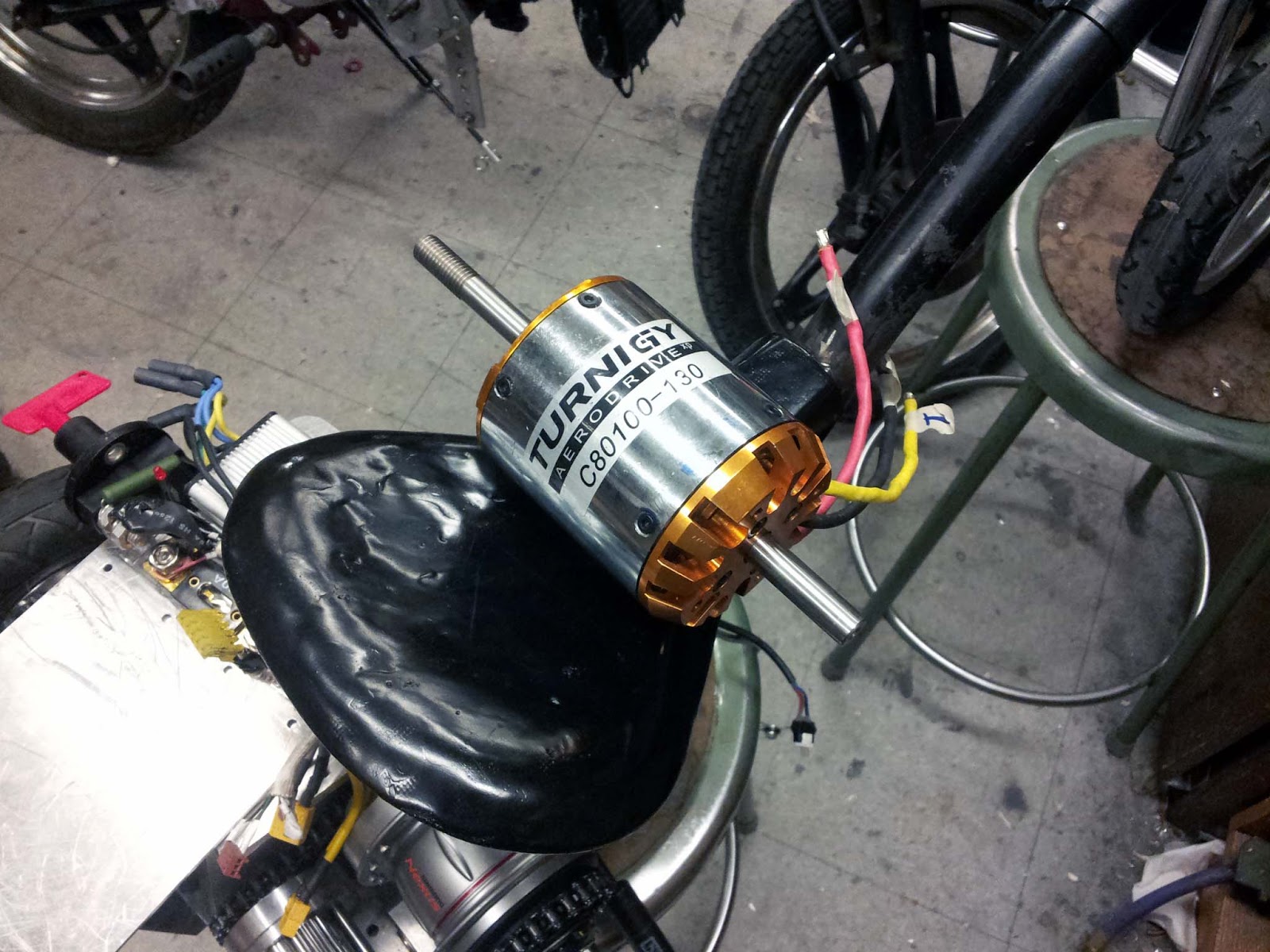
So I built another electric vehicle.  This time around, I actually did some designing before I got any parts, so this was less of a "what do I do with this cool part" project than most of the things I build are.  However, the actual construction of the vehicle was started due to the acquisition of a cool part:  the "melon" sized brushless motor that drives the tricycle.  Getting the motor was a great excuse to implement a bunch of ideas for an electric vehicle I developed after building my electric scooter.

This was my first big project done with access to real machine tools (courtesy of MITERS), so this was both my learn how to machine things and learn how to Solidworks project.  Even with just a semester working with these tools, I was able to make this vehicle significantly more refined (while simultaneously even more ridiculous) than my scooter.

The design for the vehicle was inspired by the classic Radio Flyer tricycle.  That vehicle geometry is not exactly intended for the high speed go-kart like performance I wanted, so I tried to optimize the design while retaining the tiny kids-trike aesthetic.  

And now, a brief overview of the tricycle's specifications:

Motor: Turnigy C80100-130 brushless RC outrunner
Controller: Kelly KBS48121 120A peak BLDC controller
Batteries: 39.6V 7.5 Ah A123 Systems Lithium Nanophosphate pack
Drivetrain: Manual 8-Speed Shimano internal gear hub, custom spur gear differential
Chassis: Welded steel tubing and aluminum plate construction with side-to-side leaning
Top Speed: 45+ mph, if you're feeling brave


More pictures, videos, and build log can be found after the break.

January 29, 2013

Autonomous Anti-Mouse Sentry Turret

For Bad Ideas I built a computer controlled anti-mouse sentry turret.  The turret uses a video feed from a webcam and a slightly modified version of the Project Sentry Gun Processing code to track mouse-sized objects that move across the camera's field of view.  It fires at the objects using a hacked electric airsoft gun on a pan/tilt servo platform.


January 16, 2013

Motorized Projector Screen

After the winter break, I brought a projector I got from old high school's recycling pile back to my dorm with me.   I made a screen for the projector from some blackout fabric, and motorized the raising and lowering of the screen with a small gear motor and some other parts I found.


January 3, 2013

PocketBoard

PocketBoard is a 14.5" long skateboard designed to be the opposite of my electric scooter: It is a small, simple and reliable vehicle for going short distances quickly.  At roughly 5% the weight of the scooter and some small fraction of the volume, I can easily store it in a backpack or even my laptop bag when I'm not riding it.  It has a solid oak deck with inlayed aluminum plates, and (what I assume to be) standard skateboard trucks, along with some soft 60mm diameter wheels.

PocketBoard V2 keeps the same shape and footprint, but has an aluminum deck made from the side panel of a PowerMac G5 case.


PocketBoard's rather short build thread can be found here.

November 4, 2012

Monitor Arm

By a combination of luck and keeping a close eye on the reuse mailing list, I have acquired a pair of nice, large computer monitors: A 24" 1920 x 1200 SyncMaster 245BW and a 25" 1920 x 1080 HP 2509m.  Both screens were easily repaired by replacing dead capacitors on their power supply and inverter boards.  Due to the small size of the stock dorm room desks, the two monitors plus my laptop could not actually fit on my desk with space left for anything else, so I built a monitor arm that bolts to my loft out of some 80/20 extrusion.

October 28, 2012

Nyan Hat

I present Nyan Hat, possibly my silliest and most useless project yet.  Nyan Hat was spawned from a late-night discussion involving at various times Halloween, hats, and Nyan Cat, and went from idea to completion in just over two weeks.


September 15, 2012

Loft

Using wood left over from the REX shenanigans in the East Campus courtyard, my roommate and I built a double loft in our room.  We put up the loft in record time - we only had to sleep in our institute-provided beds for a total of one night before we could sleep in the loft.  The design we used was based on another loft down the hall.  It spans the entire room, so there are no supports in the middle of the floor, and it is tall enough to walk under without having to duck.  It also includes integrated speaker mounts, a cruft shelf, and LED strip lighting.